
September is one of the best months to visit Ostend. The summer crowds have eased, the weather is still mild along the North Sea coast, and the city’s museums, churches, and heritage sites can be explored at a genuinely relaxed pace. For anyone who wants to go beyond the beach and discover what makes this city so layered and interesting, here is a guide to the landmarks worth building your visit around.
Maritime Heritage
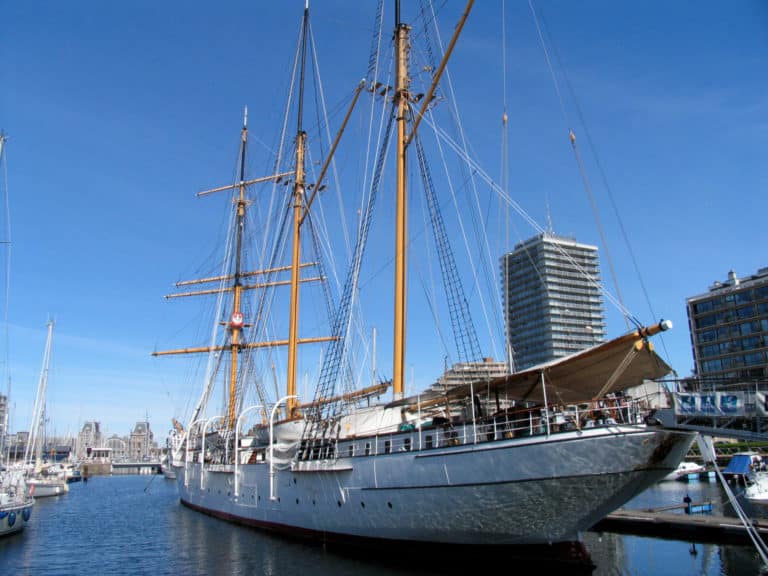
The Mercator
Moored in the harbour and impossible to miss, the Mercator is one of the most distinctive landmarks in Ostend. The three-masted sailing ship was launched in 1932, designed by polar explorer Adrien de Gerlache, and served as a training vessel for the Belgian merchant fleet before becoming a floating museum in 1964. On board, exhibits and interactive screens tell the story of its remarkable career, from sail training voyages and scientific expeditions to a brief spell in the British Royal Navy during the Second World War. Atmospheric and educational in equal measure.
Museumship Amandine
A short walk away, the Amandine offers a very different window into Ostend’s seafaring past. An Icelandic trawler that fished the North Atlantic until 1995, it now tells the story of Ostend’s fishing community with honesty and warmth. The cramped quarters, the equipment, and the personal stories of the crews make it one of the most humanly engaging museums in the city. September is a particularly good time to visit, with the harbour quieter and the early autumn light on the water at its best.
Art and Architecture
The James Ensor House
The house on Vlaanderenstraat where Ostend’s most famous son, the painter James Ensor, lived and worked is one of the most fascinating small museums in Belgium. Ensor’s paintings of masked figures, skeletons, and carnivalesque scenes were far ahead of their time and deeply rooted in the atmosphere of Ostend itself. The museum recreates his living space and studio with real intimacy, and the included audio guide brings the story to life in a way that feels personal rather than formal. Allow around 90 minutes.
Mu.ZEE
For a broader sweep of Belgian art from 1830 to the present day, Mu.ZEE is the place to go. The permanent collection includes major works by Ensor alongside paintings by Léon Spilliaert and other artists closely associated with the Belgian coast. September often brings a new temporary exhibition alongside the permanent galleries, giving returning visitors a fresh reason to come back.
Military History
Fort Napoleon
Built on Napoleon’s orders in the early nineteenth century, Fort Napoleon is one of the best-preserved Napoleonic fortifications in Europe. The star-shaped structure, surrounded by a moat and set among coastal dunes, makes the approach feel like a step back in time. Inside, the museum covers the fort’s history through both World Wars, with an audio guide included. The dunes around the fort are beautiful in early autumn and the site is quieter than in peak summer.
The Atlantic Wall Museum at Raversijde
A short distance along the coast, the Atlantic Wall Open Air Museum at Raversijde is one of the most extensive Second World War sites in Belgium. Preserved bunkers, tunnels, and military installations stretch across a significant area of dune landscape, and the visit regularly takes three hours or more. An audio guide with vibration alerts at each landmark makes navigating it a pleasure. Open through November, September is an ideal time to visit.
Landmark Architecture
The Church of Saints Peter and Paul
The most imposing building in central Ostend, the Church of Saints Peter and Paul has twin spires and a neo-Gothic interior with intricate stained-glass windows that give it a grandeur surprising for a coastal city of this size. Consecrated in 1908, it is free to enter and quiet on a September weekday. One of those stops that takes thirty minutes and stays with you much longer.
The Royal Galleries
Running along the promenade between beach and town, the Royal Galleries are one of the most distinctive pieces of Belle Époque architecture in Ostend. The neoclassical colonnades offer a panoramic sea view along their full length. In September, with the season drawing to a close, they have an unhurried quality that is hard to find in July or August.
Your Base for Exploring
Leopold Hotel Ostend is just 150 metres from the beach and ideally placed for exploring the city’s historic landmarks on foot. The Mercator, James Ensor House, Church of Saints Peter and Paul, and Royal Galleries are all within easy walking distance. Our best rates are always available when you book directly on our website.
September in Ostend is one of those combinations people tend to discover once and return to every year. The landmarks are at their most accessible, the city is at its most itself, and there is a pace to the whole experience that a summer visit simply cannot match. Book your September stay at Leopold Hotel Ostend today.


 English (UK)
  Nederlands (België)
  Français de Belgique
  Deutsch